
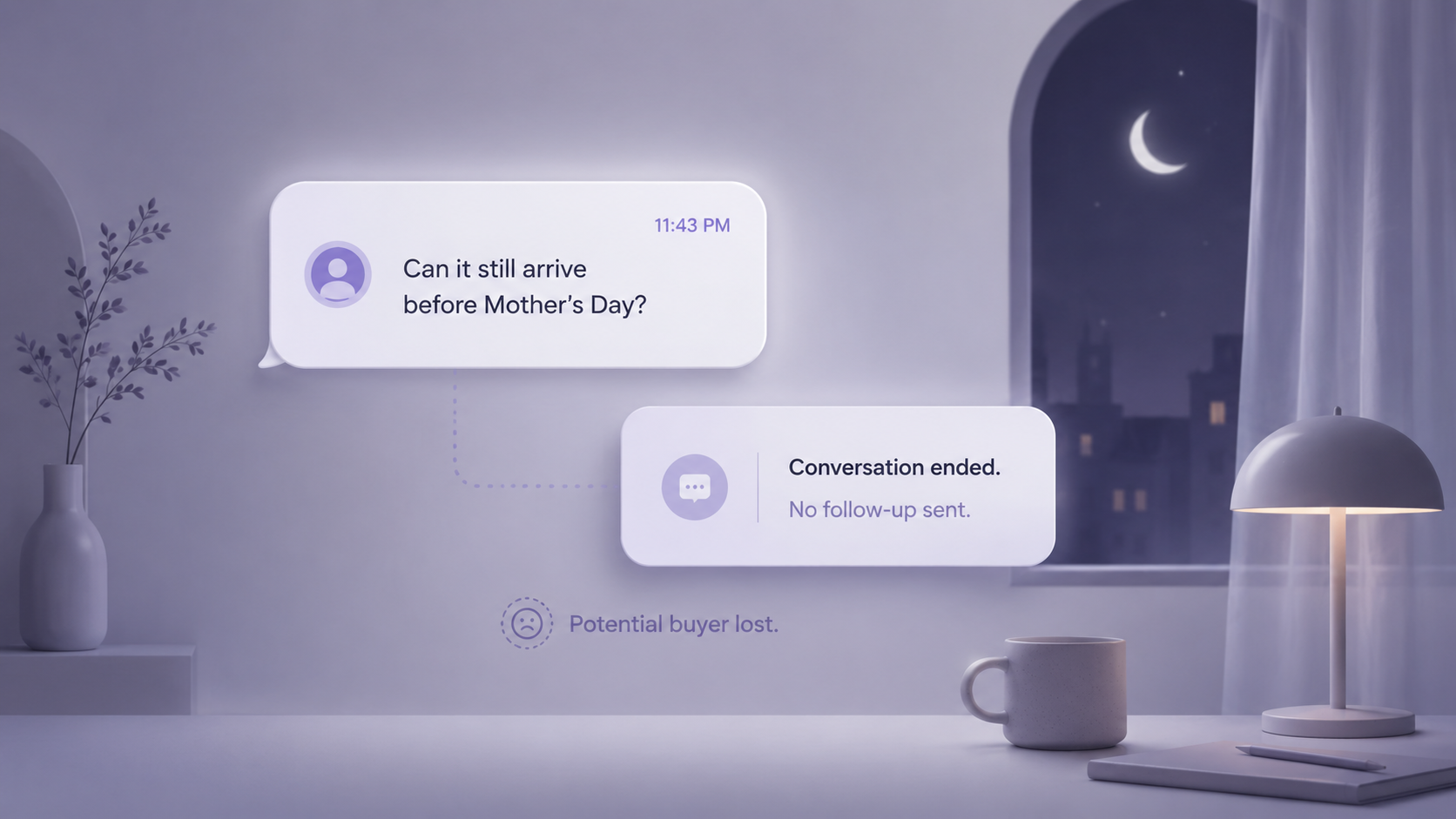
Customer service chatbots handled 23 billion interactions globally in 2025, according to Gartner's market sizing report on customer service technology. Of those, 41% occurred outside standard business hours — after 6 PM, on weekends, during holidays. The chatbot answered every question. It never followed up.
Zendesk's CX Trends 2026 report quantified the downstream effect: 53% of customers who ask a question after hours will leave the site without purchasing if they do not receive a human follow-up within one hour. The chatbot resolved the query. It did not capture the lead.
The arithmetic on a single store: 300 conversations per day × 0.41 (after-hours share) × 0.53 (leave rate without follow-up) = 65 potential leads lost per day. At a $45 average order value and a 4% conversion rate on those leads, that is 65 × 0.04 × $45 = $117 per day in missed revenue. Over a quarter, approximately $10,530. Over a year, $42,120 — for a single store running a single chatbot instance at moderate volume.
These are not hypotheticals. They are the direct arithmetic of a structural gap between conversation completion and lead identification. The chatbot performed its function: answer questions, provide information, close the conversation. The gap sits one step later — in the space between "conversation ended" and "someone realized this was a buyer."

Sales Signal is an AI layer that attaches to an existing chatbot pipeline. When a conversation ends, the chatbot drops a job into an AWS SQS queue. A background worker retrieves the transcript and sends it to an LLM for structured analysis. The LLM returns a lead card with four fields: urgency (hot / warm / cold), buying stage (comparing / ready to buy / just curious), reasoning extracted from the conversation, and a suggested next action.
The merchant sees these cards in a single "All Leads" dashboard. Instead of reading 1,000 transcripts to find the 20 that signal intent, they scan 20 cards and click "approve" on the ones worth pursuing. The workflow change is structural: the merchant's morning review shifts from open-ended scanning to binary decision-making on curated signals. The time cost drops from approximately 3 hours of transcript reading to 15 minutes of card review.
The pipeline runs in four steps:
None of these steps is individually novel. The product decision is the combination: queue architecture + LLM judgment + merchant-facing card interface. The LLM prompt is tuned to produce output specific enough that a merchant can act without reading the source transcript. The prompt enforces evidence-based reasoning — the model must cite specific customer messages rather than generating generic summaries. Early internal testing showed that without this constraint, the LLM produced vague output ("this customer seems interested") that merchants ignored.
Two questions shaped how we tuned Sales Signal's judgment.
The first is classification accuracy across verticals. A conversation about laptop specifications carries different buying signals than a conversation about organic skincare. A shopper asking about return policy on a high-ticket electronics page is checking buyer risk; the same question on a $20 candle page is curiosity. Sales Signal's prompt accounts for vertical context, so the same phrase can score "ready to buy" in one store and "just curious" in another.
The second is workflow utility. The lead card has to give a merchant enough context to decide in under ten seconds. If the merchant has to open the original transcript to verify what the card claims, the card is doing the wrong job. Every reasoning string Sales Signal generates cites a specific customer message it pulled the inference from. The merchant sees the evidence beside the verdict.
The result is sharp and useful: in stores where the chatbot handles hundreds of conversations a day and nobody on the team is reading transcripts at scale, Sales Signal surfaces a structured subset of conversations that would otherwise remain invisible. The size of that subset depends on how much unanswered buying intent already lives in your conversation log.
Stores with chatbot volumes above 200 conversations per day. Stores where the merchant or a small team manages the store without a dedicated sales operations role. Stores where the merchant has suspected — without being able to prove — that customers who asked about pricing, shipping, or product comparisons are slipping through without follow-up. The product is designed for the gap between "the chatbot answered" and "somebody followed up."
Start a 14-day free trial at YepAI . If access is full, join the early access waitlist!
Sales Signal — AI listens, judges, and writes. You approve.