
We’ve reached a point where almost every ecommerce tool claims to be “AI-powered.”
Your email tool. Your ads. Your Shopify chatbot. Even your product descriptions.
But if everything is AI…why does so little of it actually move the needle?
That’s because most of it isn’t designed to. If your current stack relies heavily on a Shopify chatbot or even something like Booster Chat, you’re likely experiencing this gap firsthand.
If you think upgrading your chatbot equals adopting AI, you’re already behind.
This guide breaks it down clearly: what an AI agent actually is, why chatbots fall short, and what this shift means for e-commerce performance and why YepAI Agents are your next upgrade!
At a glance, chatbots and AI agents aren’t completely unrelated. They’re built on overlapping technologies and often aim to solve similar problems, especially in customer support. Both are built on similar underlying technologies, and both are designed to interact with customers.
In e-commerce, they serve the same high-level purpose which is to help users find answers and move through the buying journey with less hassle.
Whether it’s a Shopify chatbot, Booster Chat, or a more advanced system like YepAI, the goal starts in the same place: improving customer experience through automation.
Both chatbots and AI agents are always-on as they are designed to be available 24/7, providing round-the-clock support and task execution. They can handle large volumes of queries instantly, support multiple languages, and automate repetitive but essential tasks like answering FAQs, guiding product discovery, or assisting with order-related questions—that’s the overlap.
The difference comes down to capability, and more importantly, impact. Chatbots operate within boundaries. They rely on predefined responses, workflows, or trained conversational patterns. Even when powered by AI, they remain reactive. They wait for input, then respond based on what they’ve been told or trained to say. They don’t understand the broader context of a customer’s behaviour, and they don’t make decisions beyond their programmed scope.
Meanwhile, AI agents work differently. They operate with autonomy. Instead of simply responding, they interpret signals, customer intent, behaviour, timing and decide what action to take. A YepAI agent, for instance, doesn’t just answer a question. It evaluates what the customer is trying to achieve and determines how to move them closer to conversion. This becomes even more apparent in conversation.

Chatbots can handle straightforward interactions reasonably well, but struggle when conversations become layered or outcome-driven. They follow logic trees, even if those trees are powered by natural language processing.
AI agents aren’t bound by rigid flows. Instead, they adapt in real time because they’re not just reacting to text but to context, they can navigate more complex interactions with flexibility from guiding, influencing, and optimizing the experience as it unfolds.
In simple terms, chatbots are built to respond. However, AI agents are built to decide and act on those decisions. And in e-commerce, that difference is what separates basic automation from real growth.
Let’s get specific. The problem with most e-commerce chatbots isn’t just that they’re limited, it’s that they break exactly where revenue decisions matter most.
Here’s where they fail and what YepAI agents do differently.
Chatbots rely heavily on static knowledge. Most Shopify chatbot setups pull from outdated FAQs or delayed data syncs. So when a customer asks something time-sensitive like stock availability, pricing, or delivery timelines, the answer ends up being wrong or outdated.
That’s not just a bad experience, it immediately erodes trust. That’s what YepAI Agents becomes a solution since YepAI agents operate on live, continuously synced data. Every response is grounded in what’s actually happening in your store right now, not what was true last week.
Chatbots struggle with anything beyond simple as they can only take one-step interactions. If you start asking them something layered like modifying an order, comparing products with constraints or handling partial returns, the chatbots breaks down quickly and they keep answering in repeated robotic answers.
As a result, conversations loop, stall, or end prematurely. YepAI agents handle this differently. They break down complex intent into actionable steps, track context across the conversation, and resolve multi-step requests without losing flow.
Traditional chatbots respond the same way regardless of customer sentiment. Whether a user is frustrated, confused, or excited, the tone remains flat and mechanical because chatbots doesn’t offer sympathy. That’s a problem, especially in high-stakes situations like delayed orders or damaged products.
YepAI agents detect sentiment in real time and adjust accordingly. YepAI Agents have real-time sentiment analysis that tracks customer emotion throughout the conversation from positive, negative, frustrated, excited, confused with trend monitoring, offering proactive solutions, or escalating to a human when needed.
Even when escalation is required, most chatbot systems fail badly. The handoff to a human agent is disconnected with no context, no history, no prioritisation. Customers are forced to repeat themselves, which kills the trust and ending the conversion possibility.
YepAI fixes this by transferring full context: conversation history, intent, sentiment, and suggested next actions. The human steps are in because the goal of an AI Agent is to never let the customer repeat themselves again.
Most Shopify chatbots rely on generic pop-ups triggered by timers which ends up interrupting users at the wrong moment with irrelevant messages. Instead of helping the customers, they become annoying.
YepAI agents use behavioural triggers. They observe signals like hesitation, repeated product views, or exit intent and engage at the moment it actually matters, with messaging tailored to the situation.
Just like what we mentioned in #2 reason why chatbots fail is because they struggle with complex activities, making them typically stop at information. They usually might say “contact support” or “check your email,” but they don’t solve the problem. Resulting in adding more steps that eventually customers stop associating and end up getting annoyed and simply stop converting.
Through context protocol tool integration, YepAI agents don’t just respond, they execute real action helping inside the conversation checking inventory, applying offers, updating orders, making contents, process payments or triggering workflows.
Traditional chatbots operate in isolation, so when a customer who interacts on your website, then returns later or through another channel, they basically go back and start from zero again. Every returning customer is treated as new visitors and previous purchase history and preference are lost, and that’s a broken experience for customers who expect continuity.
YepAI agents handle this differently. Within your Shopify store, YepAI maintains session memory where AI agents recognize returning visitors and continuing interactions with relevant context. Instead of starting from zero, customers feel acknowledged and understood from the moment they re-engage. It’s a simple shift, but it changes how customers experience your brand: not as a series of disconnected interactions, but as one continuous journey.
Most chatbot deployments don’t fail because of the technology, they fail because there’s no system behind them. They’re installed, ticked off a checklist, and left running. No clear KPIs. No defined success metrics. No visibility into whether they’re actually improving conversions or quietly hurting the customer experience. Without measurement, there’s no optimization, and without optimization, there’s no growth.
YepAI changes that. Instead of treating automation as a one-time setup, YepAI agents operate within a continuous optimisation loop. Every interaction is tracked and analysed from customer intent and behaviour to outcomes like conversions, engagement, and drop-offs—creating a clear feedback system. You’re not guessing what works. You’re seeing it in real data.
With YepAI, you can understand how conversations influence revenue, identify friction points in the customer journey, and refine strategies based on actual performance and not assumptions.
When a customer hesitates before purchasing, a chatbot typically waits for a question. If the user asks about shipping or pricing, it responds. If not, nothing happens.
An AI agent, on the other hand, detects behavioural signals like time on page, scroll depth, or repeated product views. It evaluates intent and decides what action increases the probability of conversion. It might trigger a personalised offer, recommend a better-fit product, or create urgency using real-time data. That action doesn’t just stay in chat, it can extend across email, SMS, or onsite experiences.
In a post-purchase scenario, the difference becomes even clearer. A chatbot answers “Where is my order?” when asked. An AI agent anticipates that question before it’s even asked. It proactively sends updates, identifies upsell opportunities, and personalises follow-ups based on behaviour.

While the one reacts. AI agents orchestrate the customer journey.
Reality: Unlike most of the belief of everyone that there will be a time where AI will replace humans, no they aren’t. Instead, they replace manual execution, but definitely, not strategic planning and thinking. They handle repetitive optimization, data analysis, and real-time decisions at scale, while humans focus on direction, positioning, and growth strategy.
Reality: Chatbots wait. AI agents act. A chatbot responds to questions. An AI agent interprets behaviour, predicts intent, and takes action from across ads, onsite experience, email, and more. This isn’t better support. It’s operational automation.
Reality: Bad automation removes control. Good automation enforces it. AI agents operate within strict parameters from budgets, performance thresholds, and testing rules. Every action is measurable, adjustable, and reversible. You’re not giving up control, you’re removing anything that limits the flow of a process, which causes delays, inefficiencies, or added costs.
Reality: Unlike what you mostly heard, they don’t replace strategy, they execute it continuously. AI agents optimise in real time, but outcomes still depend on inputs: your goals, your constraints, your data. Without human direction, AI agents don't do anything and they just scale inefficiency.
Reality: AI agents level the playing field. Smaller teams benefit the most because they gain capabilities that normally require entire departments: media buying, CRO, CRM, and analytics. It’s not about size. It’s about leverage.
Reality: Content is the lowest-leverage use case that you could think of for AI agents. They operate across the full growth stack managing paid ads, improving conversion rates, recovering abandoned carts, and orchestrating lifecycle marketing. They don’t just create, again, they execute.
Reality: Uncontrolled systems are risky. Structured systems are not. AI agents operate within guardrails from budget caps, controlled experiments, and performance limits. Every action is tracked. Every change is reversible. Every decision is data-backed.
E-commerce has shifted. It’s no longer about responding faster, it’s about making better decisions at scale. This is where YepAI differentiate themselves. Instead of layering intelligence onto a chatbot, they replace the model entirely with something designed for performance.
Instead of relying on one generic bot to handle everything, YepAI is built as a role-based AI agent system. That means different agents are designed to solve different parts of the ecommerce operation, just like a real team would.
For example, YepAI can deploy specialized agents for customer service, sales, marketing, operations, merchandising, retention, and more. Each one has a defined role, a clear scope, and a practical job to do inside the business.
On the customer service side, YepAI agents can handle post-purchase support, real-time order tracking, FAQ resolution, multilingual conversations, and human handoff when issues become more complex. On the sales side, agents can support product recommendations, upsells, discount delivery, cart recovery, and lead capture.
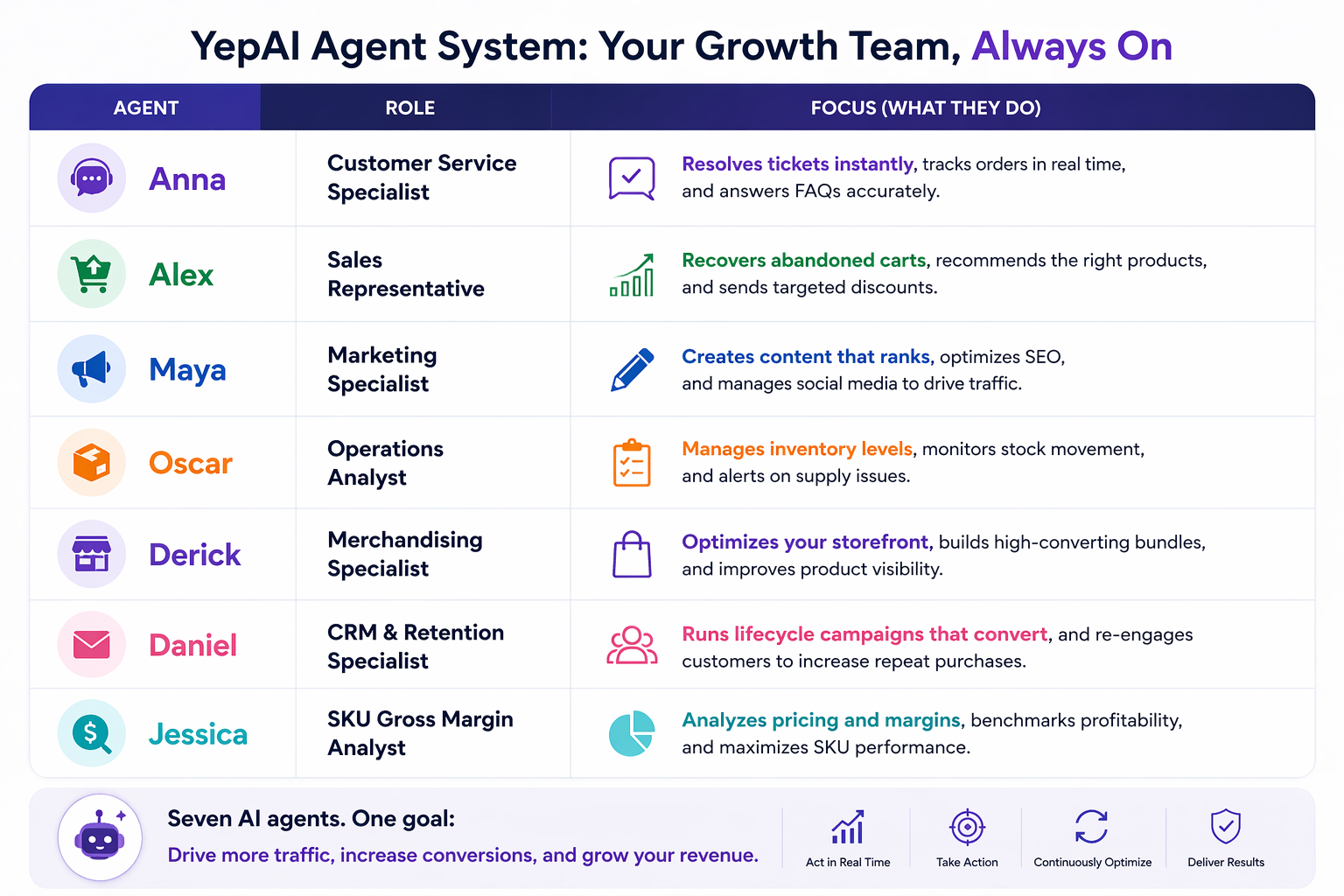
Additionally, on the marketing side, YepAI can assist with blog writing, SEO keyword research, social content, and image generation. Operationally, the system can also support stock checks, product catalogue analysis, recent order summaries, and other backend workflows that impact customer experience. That’s what makes the model stronger.
Instead of forcing one chatbot to perform every function poorly, YepAI distributes work across specialized agents built for specific outcomes. This is also why YepAI feels less like a support widget and more like an AI workforce embedded into your Shopify ecosystem.
Each agent is designed around a real business problem, whether that’s reducing support load, recovering abandoned carts, improving merchandising decisions, or helping your team move faster without adding headcount.
Some of these agents are already active, while others are being rolled out in stages. But the model is clear: YepAI isn’t trying to replace one support box with another. It’s building an AI agent system that mirrors how modern e-commerce teams actually operate.
And that’s the real leap forward. A chatbot gives you one conversation layer which aren’t no longer enough in Shopify. But with, YepAI Agent Team, it gives you a system of specialized AI agents working across the customer journey.
Stop asking how to improve your chatbot. Instead, be proactive and start asking what decisions your business should be automating. That’s where your AI agents help you to begin, and that’s exactly where YepAI is positioning the future of e-commerce.
If you’re still relying on a Shopify chatbot, Booster Chat, or any traditional support automation, you’re solving yesterday’s problem. The brands pulling ahead right now aren’t just responding faster, they’re the one who’s making smarter, automated decisions that directly impact revenue.
With YepAI, you’re not installing another chatbot. You’re deploying an AI agent that actively:
If you’re serious about scaling your ecommerce performance, the next step isn’t optimisation, it’s replacement.
Start your free 14-day trial with YepAI: https://bot.yepai.io/auth/register
We’re also expanding the YepAI agent system as we introduce our two new specialised agents: Leo (Paid Ads Specialist) and Jennie (CRO Specialist) are launching soon to help brands scale traffic, optimise funnels, and drive even more revenue from every visitor.
Join the waitlist to get early access before public release.
Because the longer you stay on chatbots, the more growth you leave on the table, but with the YepAI Agent Team, you’re not reacting to customers, you’re driving outcomes!