
If you're searching for the best AI solution for your Shopify store, you've probably narrowed your options to Yep AI, Tidio, and Shopify Inbox.
At first glance, they all promise to help you communicate with customers, answer questions, and increase conversions. But once you look beyond the marketing pages, you'll discover they solve very different problems.
Some focus on live chat. Some automate basic customer support. Meanwhile, others act as a complete AI employee that works across your ecommerce business.
Choosing the wrong platform can mean paying for software that still requires constant manual work. Choosing the right one can reduce support costs, improve response times, recover abandoned carts, and help generate more sales around the clock.
In this guide, we'll compare Yep AI vs Tidio vs Shopify Inbox across the features that matter most for Shopify merchants, including:
By the end, you'll know which AI Employee is the right fit for your business.
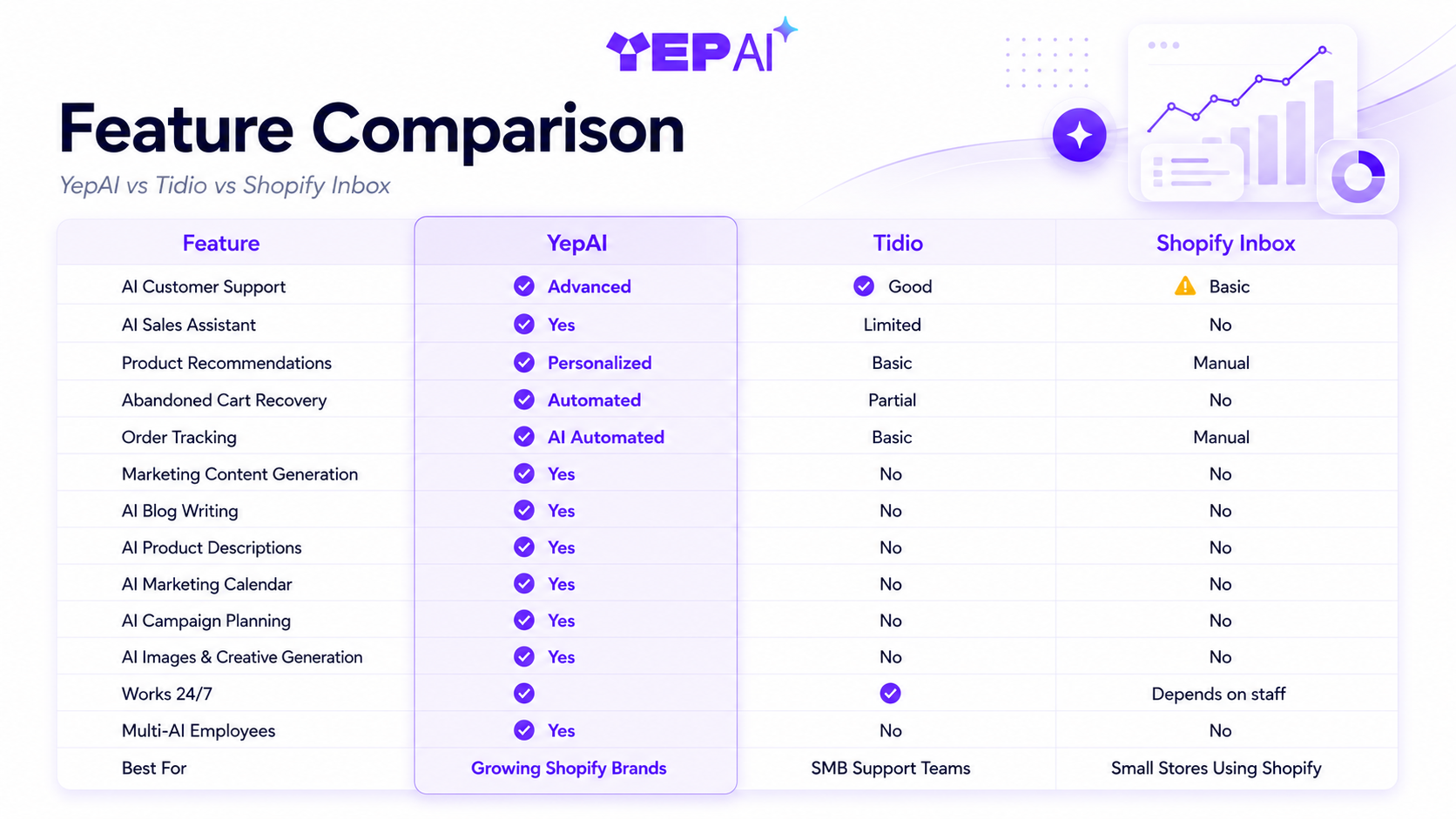
Here's the easiest way to understand these three platforms.
Shopify Inbox is primarily a messaging inbox. While, Tidio is an AI chatbot with live chat capabilities.
Yep AI is an AI Employee platform that combines customer support, sales, marketing, and ecommerce automation into one system.
You can clearly see the difference, and it becomes even more important as your store grows. YepAI doesn't just provide one AI employee—it gives you multiple specialized AI employees, each designed to support different areas of your business and help it scale.
Imagine receiving hundreds or even thousands of customer conversations every week.
Customers aren't just asking:
They're also asking:
At the same time, your AI marketing specialists Maya is creating product descriptions, blog articles, emails, landing pages, Meta ads, and social posts. On the other hand, only traditional chat tools only solve one part of this workload. However, with an AI employee, it helps across multiple departments.
Shopify Inbox is Shopify's free messaging platform that lets merchants communicate with customers through their online store. It's designed for merchants who want a simple way to answer customer questions without purchasing additional software.
For very small stores, this can be enough. However, Shopify Inbox still relies heavily on human agents. Take note of this too, when customer conversations increase, your support workload increases too.
Tidio is a customer communication platform that combines live chat with AI-powered chatbot automation. Compared to Shopify Inbox, Tidio offers significantly more automation.
Instead of manually answering every message, businesses can automate repetitive customer questions. For example:
Its AI chatbot can reduce repetitive support tickets and provide faster customer responses.
Tidio is ideal for businesses looking to automate customer support without investing in a larger AI platform. However, its focus remains customer conversations and not broader ecommerce operations.
Yep AI takes a different approach. Instead of starting from a question of "how do we suggest a good reply," Yep AI works with question like "what would a great human employee actually do with this conversation?" That means resolving the ticket, updating the order, applying the right discount, or escalating with full context, without a store owner rewriting every draft.
Additionlly, rather than automating only conversations, Yep AI helps automate entire business functions. That means it can support customers, assist shoppers during the buying journey, generate marketing assets, create SEO content, recommend products, recover abandoned carts, and continuously learn your brand voice.
For Shopify merchants, this means fewer tools to manage and more workflows handled from a single AI-powered platform. Unlike traditional chatbots that mainly respond to questions, YepAI combines customer support, sales assistance, marketing automation, and content creation into one system.
A Yep AI AI Employee can:
For growing Shopify businesses, this shifts AI from being just a support tool to becoming an active contributor across multiple teams.
The role of AI in ecommerce has changed significantly over the last few years. Early AI tools were primarily designed to answer customer questions through live chat or automated workflows. While these solutions helped businesses reduce repetitive support tickets and improve response times, they were still limited to handling conversations. More complex tasks often required human intervention, leaving store owners and support teams to complete the work manually.
Today, Shopify merchants expect AI to contribute far beyond customer support. As businesses grow, so do the demands of managing marketing campaigns, updating product pages, creating content, recovering abandoned carts, and delivering personalized shopping experiences. Rather than investing in a separate tool for every task, many businesses are beginning to look for AI that can support multiple departments and complete meaningful work across the entire ecommerce operation.
This shift is reflected in industry research. According to McKinsey's latest research on generative AI, 71% of organizations now regularly use generative AI in at least one business function (up from 65% the previous year). Showcasing that organizations are seeing the greatest business value from AI in customer operations, marketing, and sales—areas where automation helps teams work more efficiently while improving customer experiences. Instead of simply assisting employees, AI is increasingly becoming an active contributor to business operations.

This is the philosophy behind Yep AI. Rather than functioning as another chatbot, Yep AI is built around the concept of AI Employees with specialized AI roles that work together to support different parts of an ecommerce business. Instead of relying on one general-purpose assistant, merchants can use dedicated AI Employees for customer support, sales, marketing, and product intelligence, allowing each one to focus on the tasks it was designed to perform.
Although AI chatbots and AI Employees are often grouped together, they are built with different objectives in mind. A traditional chatbot is designed to respond to customer messages by answering common questions or guiding visitors through predefined workflows. This makes chatbots effective for handling frequently asked questions, providing order updates, and reducing repetitive support requests.
An AI Employee takes the conversation a step further. Instead of simply generating a response, it is designed to help complete the work behind that interaction. A customer asking about an order may also need a tracking update, a recommended product, a discount code, or assistance completing a purchase. Rather than treating these as separate tasks, an AI Employee can support the entire customer journey by combining customer service, sales assistance, and ecommerce automation into a single workflow.
For growing Shopify businesses, this distinction becomes increasingly important. Customer conversations rarely exist in isolation—they often lead to sales opportunities, marketing activities, or operational tasks. The more responsibilities AI can manage from one platform, the less time merchants spend switching between tools and manually completing follow-up work.
One of the biggest differences between Yep AI and traditional chatbot platforms is its use of multiple specialized AI Employees. As businesses grow, expecting a single AI assistant to manage every department becomes increasingly inefficient. Marketing requires different knowledge and objectives than customer support, while sales conversations require a different approach than product optimization.
Yep AI addresses this challenge by assigning different responsibilities to dedicated AI Employees, much like a growing business relies on specialists rather than a single generalist. Its AI Customer Support Employee focuses on resolving customer inquiries and providing instant assistance. The AI Sales Employee helps shoppers discover products, answers pre-purchase questions, and encourages higher-value purchases through intelligent recommendations.
Furthermore, the AI Marketing Employee generates SEO blogs, advertising copy, email campaigns, landing pages, and social media content, while the Product Intelligence Employee helps optimize product information to improve discoverability and conversions.
Because each AI Employee specializes in a particular business function, merchants benefit from more focused automation while still managing everything through a single platform. This approach allows businesses to automate a wider range of ecommerce workflows without juggling multiple disconnected AI tools.
Many Shopify merchants begin with a live chat solution because it solves an immediate need: answering customer questions faster. However, as order volume increases, customer support becomes only one part of a much larger operation. Marketing campaigns need to be launched regularly, product catalogs require constant updates, abandoned carts need to be recovered, and customers expect personalized shopping experiences across multiple channels.
This is where the difference between a chatbot and an AI Employee becomes more apparent. While chatbots continue to play an important role in customer communication, they are typically designed around a single function. AI Employees are designed to contribute across multiple areas of the business, helping merchants automate not only conversations but also the work that drives growth.
For businesses planning to scale, this broader approach can simplify operations, reduce reliance on multiple software subscriptions, and allow teams to focus more of their time on strategic initiatives instead of repetitive administrative tasks.
At first glance, YepAI, Tidio, and Shopify Inbox may seem like similar solutions because they all use AI to help Shopify merchants. But once you look at what each platform is designed to do, the differences become clear.
Shopify Inbox is primarily a messaging tool. Tidio combines live chat with AI-powered automation to help businesses respond to customer inquiries more efficiently.
YepAI takes a different approach.
Instead of focusing on a single function, YepAI is built as an AI Employee platform that supports multiple business functions across your ecommerce store. Rather than simply answering customer questions, it helps automate customer support, sales, marketing, and content creation—all from one platform.
As your business grows, so do the demands on your team. Customer conversations increase, marketing campaigns become more frequent, new products require fresh content, and keeping everything up to date takes more time. YepAI is designed to help manage these growing workloads without adding more software or expanding your team.
Unlike traditional chatbot platforms, YepAI gives you access to multiple AI Employees, each trained for a specific role within your business.
Instead of relying on one AI assistant to do everything, each AI Employee focuses on its own area of expertise.
Available 24/7 to answer customer questions instantly. It can help shoppers with:
This helps reduce repetitive support tickets while providing customers with faster responses at any time of day.
The AI Sales Employee goes beyond answering questions by actively helping customers make purchasing decisions. It can:
Rather than acting as a passive chatbot, it supports customers throughout their buying journey to help increase conversions.
Marketing often requires creating content across multiple channels, and that's where YepAI's AI Marketing Employee comes in. It can generate:
Because it learns your brand voice, the content stays consistent across your marketing channels.
So have you made your decision yet? Shopify Inbox, Tidio, and YepAI all help Shopify merchants improve customer interactions, but they are built to solve different challenges.
If your primary goal is to provide a simple way for customers to contact your team, Shopify Inbox offers a straightforward messaging solution that's easy to set up. If you're looking to automate customer support with AI-powered chat and reduce repetitive support tickets, Tidio provides more advanced automation while remaining focused on customer conversations.
Yep AI takes a broader approach. Rather than limiting AI to customer support, it introduces specialized AI Employees that work across customer service, sales, marketing, and product intelligence. As your business grows, these responsibilities often expand together, making it increasingly valuable to have AI that can support multiple functions instead of just answering questions.
Ultimately, the right choice depends on your business goals. If you're simply looking for a chatbot, Shopify Inbox or Tidio may meet your needs. However, if you're looking to automate more of your ecommerce operations, streamline repetitive work, and equip your Shopify store with AI Employees that contribute across your business, Yep AI is designed to help you grow with greater efficiency.
Running a successful Shopify store takes more than responding to customer messages. Every day, your business needs to create marketing campaigns, optimize product pages, recover abandoned carts, answer customer questions, recommend products, and keep shoppers engaged throughout their buying journey.
Instead of managing multiple tools for each task, imagine having a team of specialized AI Employees working together from a single platform.
With Yep AI, you can automate customer support, sales assistance, marketing content, and product intelligence while maintaining a consistent brand voice across every customer touchpoint. Whether you're looking to improve response times, increase conversions, or free up your team to focus on strategic growth, Yep AI is built to support your business as it rise above your competitors.
Start your free 14-day trial today and discover how specialized AI Employees can help your Shopify store work smarter, grow faster, and deliver better customer experiences.
With Yep AI, you can think less, stress less, and let AI Employees handle the rest.