
Every AI tool for Shopify calls itself something different. Heyy says "AI agents." OctoClaw says "AI specialists." Sintra AI says "AI employees." YepAI says "AI team members."
But these are not just branding differences. They reflect real capability gaps. A store owner who buys an "AI agent" expecting it to handle email, sales, and support across every channel is going to be disappointed when they discover it only answers chat questions from a script.
Let us break down what each term actually means.
AI chatbots are the oldest and simplest category. They have been around since 2016, and most Shopify stores have encountered them.
A chatbot works from rules. You define questions and answers, build conversation flows, and the chatbot follows them. If a customer asks something outside the predefined script, the chatbot either says "I do not understand" or routes to a human.
Modern chatbots (2024+) use large language models to understand natural language better than the old keyword-matching systems. But the core limitation remains: chatbots respond to what customers ask. They do not initiate, do not learn from patterns, and do not take actions beyond the conversation.
What a chatbot can do:
Answer FAQ-type questions (shipping times, return policies, store hours). Collect customer information (name, email, order number). Route conversations to human agents based on topic or keywords. Provide instant responses 24/7 for simple, predictable questions.
What a chatbot cannot do:
Recommend products based on browsing behavior. Process returns or issue refunds. Follow up with customers after a purchase. Handle conversations across email, SMS, and social media simultaneously. Learn from past interactions to improve over time.
Examples on Shopify: Tidio (basic tier), many free Shopify chat apps, early-generation Zendesk chat bots.
Price range: Free to $50/month for most Shopify chatbot tools.
AI agents represent the current mainstream category. They go beyond scripted responses and can make decisions within boundaries you set.
The key difference from chatbots: an AI agent can take actions. If a customer asks about a product, the agent can check inventory in real time, pull up relevant reviews, calculate shipping costs, and make a recommendation — all without a human telling it what to do at each step.
Agents also handle ambiguity better. A customer typing "I want something for my mom’s birthday, she likes gardening and hates pink" would stump most chatbots. An AI agent can parse the intent, filter your catalog, and suggest three specific products.
But most AI agents are still single-channel. They work on your website chat widget. They do not handle email threads, Instagram DMs, or follow up with customers who abandoned their cart three days ago.
What an AI agent can do:
Everything a chatbot does, plus: product recommendations based on conversation context, real-time inventory and pricing lookups, guided shopping experiences ("What is your skin type? What is your budget?"), basic order management (status checks, simple modifications), learning from past interactions to improve accuracy.
What most AI agents cannot do:
Work across multiple channels simultaneously. Handle complex post-sale issues (damaged items, partial refunds, exchanges). Send proactive outbound messages. Manage ongoing customer relationships over time.
Examples on Shopify: Heyy (AI agent builder), OctoClaw (AI specialists per task), Reference AI (product discovery agent).
Price range: $29 to $499/month depending on features and conversation volume.
AI employees are the newest category, and the term itself is still being defined by the market. Here is what separates them from agents.
An AI employee is designed to function as a team member, not a tool. The difference sounds subtle but changes everything about how it operates.
A tool sits in one channel and waits for input. A team member works across channels, takes initiative, follows up, and handles the full lifecycle of a customer interaction from first question to post-purchase check-in.
Concretely, an AI employee on Shopify can: respond to a chat question about sizing, then send a follow-up email with measurement guides an hour later, then handle the return request via the same email thread two weeks later, then flag the customer for a loyalty discount when they return to the site three months later. One continuous relationship, not four separate tool interactions.
The other key difference is the work model. AI agents are typically sold per-interaction or per-credit. AI employees are sold like actual staff — a flat monthly cost regardless of how much they work. You would not pay a human employee per conversation. The same logic applies here.
What an AI employee can do:
Everything an agent does, plus: work across chat, email, SMS, and social DMs from one unified identity. Initiate conversations proactively (cart abandonment, post-purchase check-ins, restock reminders). Handle complex multi-step workflows (process a return, issue a refund, suggest an exchange, follow up to confirm satisfaction). Build ongoing customer context that persists across interactions and channels. Operate on a flat cost regardless of volume.
What AI employees still struggle with:
Highly emotional situations where customers want human empathy (though escalation to humans should be built in). Legal or compliance-sensitive issues. Creative problem-solving for truly novel situations. Building personal relationships the way a great human CS rep can.
Examples on Shopify: YepAI (AI team member), Sintra AI (AI employees with credit-based pricing).
Price range: $49 to $500+/month depending on provider and pricing model.
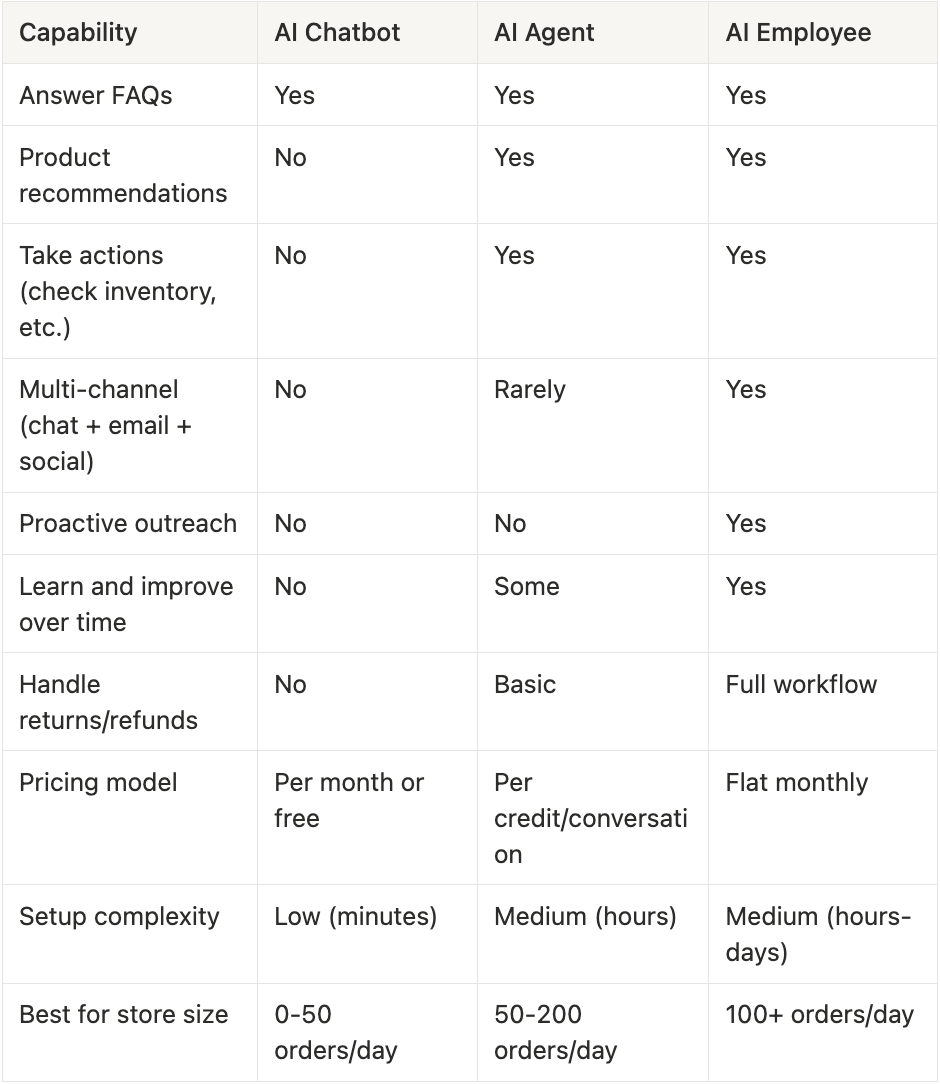
Start with your current pain point, not the technology.
"We just need someone to answer basic questions at 2am." A chatbot is fine. Set it up in 10 minutes, cover the FAQs, route everything else to your morning email queue. Do not overspend on capabilities you will not use yet.
"We are losing sales because shoppers cannot find the right product." An AI agent built for product discovery (like Reference AI) solves this specific problem. You need smart recommendations, not full-channel coverage.
"We are spending $5K+/month on CS agents and still missing after-hours messages." This is where an AI employee makes financial sense. The cost savings from replacing or supplementing 1-2 human agents pays for the tool many times over.
"We have 3 people answering the same questions on chat, email, and Instagram." An AI employee that unifies these channels into one workflow eliminates the duplication. Your team can focus on the hard stuff.
One thing that does not change regardless of which category you pick: the AI tool should make your customers' experience better, not just your costs lower. If customers start complaining about robotic answers or missing context, you have either picked the wrong category or implemented it poorly.
Is an AI employee the same as a chatbot?
No. A chatbot follows scripts and answers predefined questions on one channel. An AI employee works across multiple channels, takes autonomous actions, learns from interactions, and functions as a digital team member handling the full customer journey. They share the ability to respond instantly, but the scope and capability are different.
Do I need to replace my human team with an AI employee?
No. Most stores get the best results with a hybrid approach: AI handles the repetitive 60-80% of interactions, human agents handle complex cases that need judgment and empathy. The AI employee reduces how many human agents you need, not whether you need them.
Can an AI chatbot become an AI agent or employee through updates?
Some platforms evolve their capabilities over time, but the architecture is fundamentally different. Upgrading from a chatbot to an agent usually means switching tools entirely. Check whether your current provider has a clear product roadmap toward agent or employee capabilities before committing long-term.
Which AI category works best for Shopify specifically?
Shopify stores benefit most from AI agents or AI employees because of the ecommerce-specific needs: product recommendations, order tracking, returns processing. Basic chatbots miss too much of what Shopify customers actually need help with.