
Good digital staff know your store and learn from what works. Today, at YepAI we're answering a question our early merchants kept asking: how to make product page operations stop being one-off optimization and start being a closed loop.
A few weeks ago, a Shopify merchant on our beta list was staring at Analytics. One new SKU: 800 clicks last week, 12 add-to-cart, zero orders. Their next move was the routine. Open Yoast, score 8.2, fine. Open Jasper, regenerate the description, cleaner. Copy back into Shopify admin. Check again in a week.
A week later, conversion hadn't moved.
Break down how merchants run product page operations today and you get three tools that don't talk to each other. SEO tools like Yoast and Smart SEO tell you which keywords are missing. They do that job fine. AI writers like Jasper and Copy.ai generate clean product descriptions from a prompt. They don't know your brand voice, and they don't know how competitor pages in your category are structured.
Competitor monitors report what competitors launched today. They don't tell you why your own pages underperform. Each does its piece. None of them share context. So the merchant becomes the glue: pull low-CTR SKUs from Analytics, read competitor pages for structure, paste prompts into the AI writer, copy the output back into Shopify, check three weeks later. In a mid-sized DTC brand, that glue work consumes one full-time role.
We built Cody for the glue itself.
Cody joins Anna and Alex as the third member of Yep AI's digital staff. Anna handles your customer service, Alex drives sales, and Cody now owns product page operations.
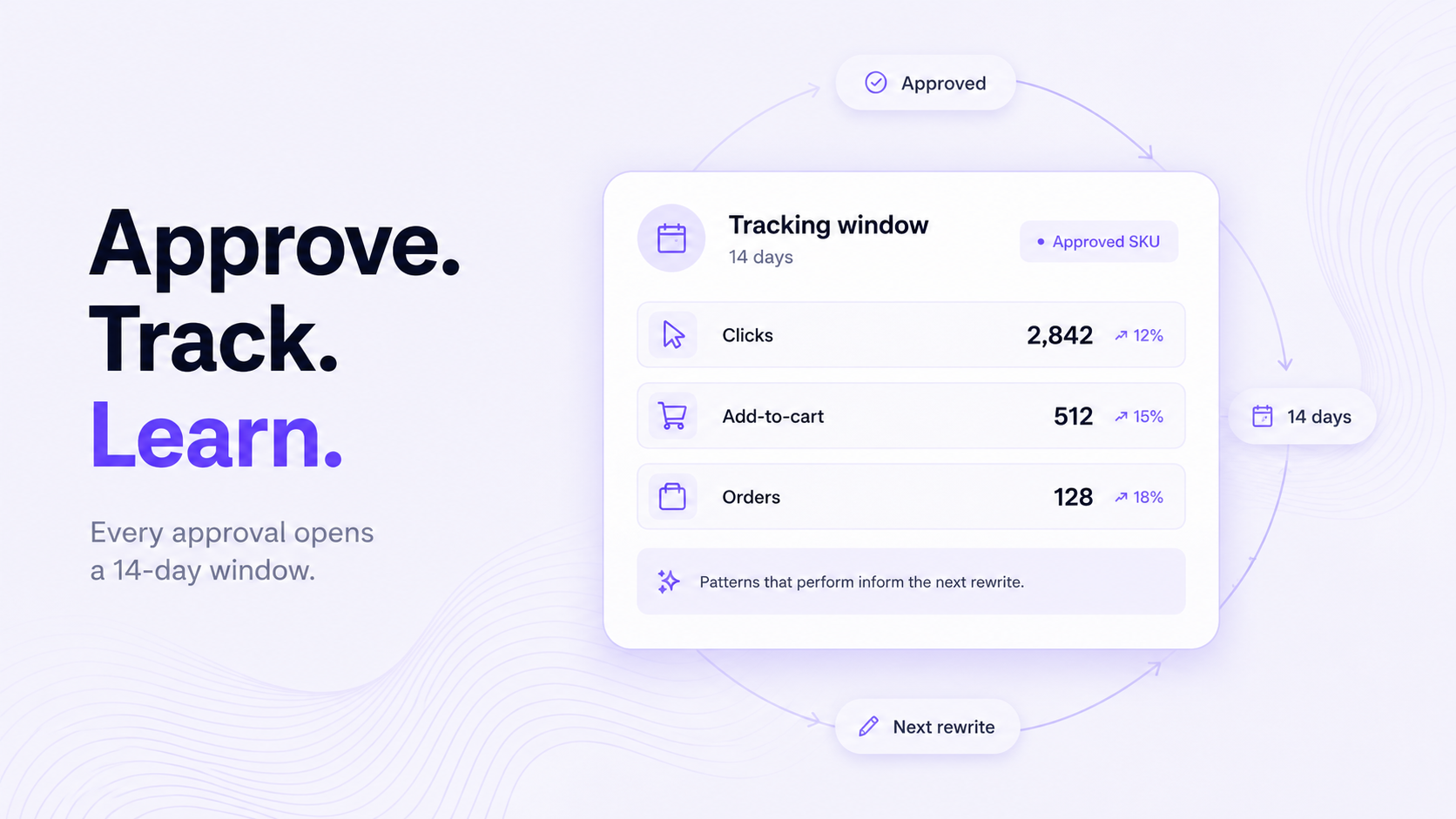
The job has three parts. Cody reads your brand voice, competitor page structures, the FAQs Anna captures from customer conversations, the "recommended-but-not-purchased" SKUs Alex flags, and the CTR and conversion data Shopify Analytics gives you for every product. Cody generates structured drafts in one pass: title, description, SEO keywords, image alt text. And Cody tracks what happens after you approve a draft, monitoring before/after CTR and conversion in a 14-day window and feeding the result back into the next generation.
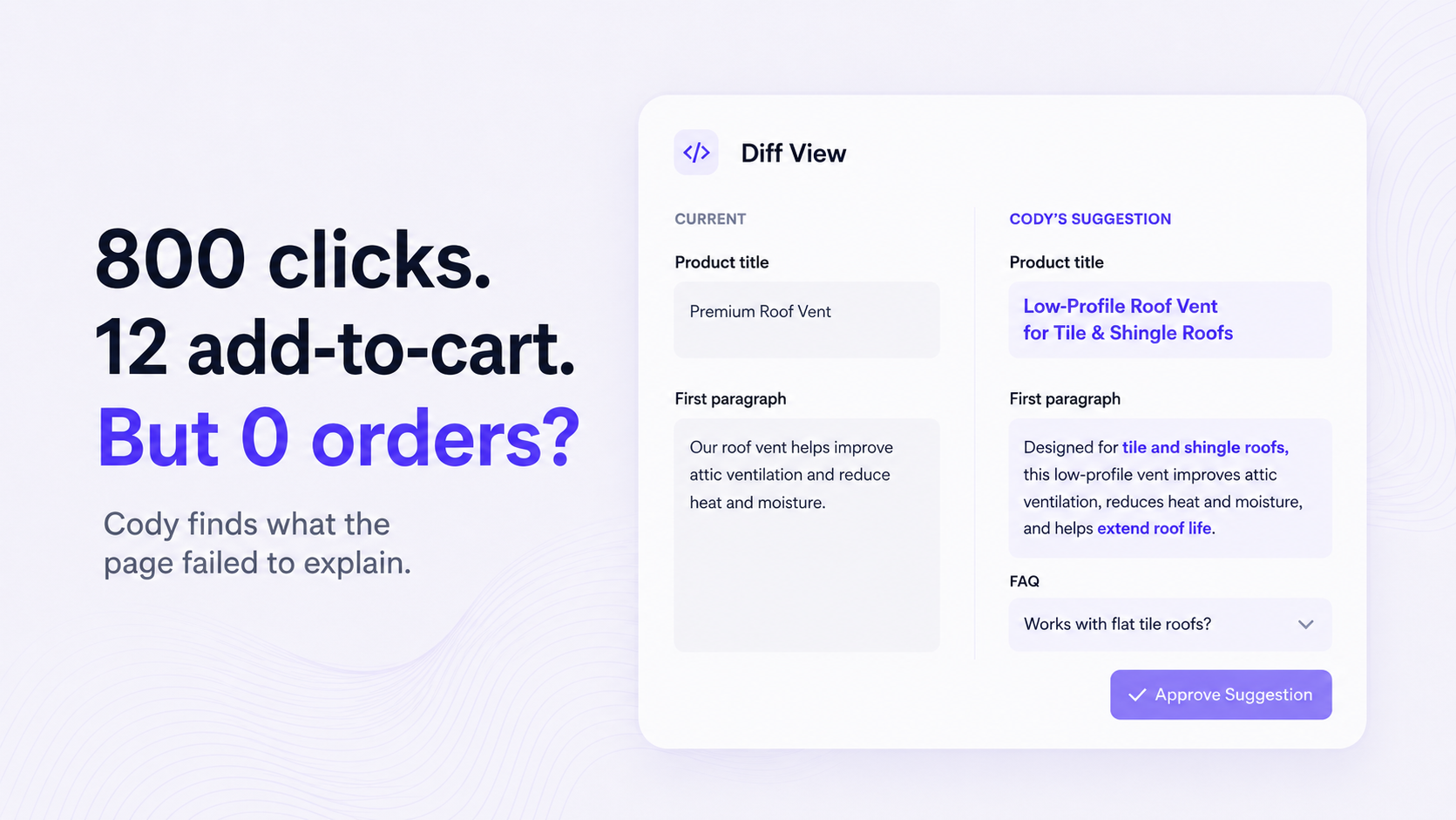
Take the 800-clicks-zero-orders SKU from earlier.
Cody pulled the SKU's data and cross-checked it against Anna's customer service logs. Six recent conversations all asked the same question: "does this run small or true to size?" Cody added a sizing section to the description draft.
Then Cody looked at Alex's recommendation logs. The SKU had been recommended 500 times, clicked 80, added to cart 5. A classic mismatch between title and buying intent. Cody rewrote the title to lead with the benefit shoppers were actually searching for.
Cody also scanned three competitor pages in the same category to see how they structured the sizing block, taking only the structural pattern, not the words.
Ten seconds after the merchant opened the SKU, Cody pushed a draft to the Shopify admin: new title, new description with sizing on top, refined SEO keywords, revised image alt text. The Diff View showed both versions side by side. The merchant clicked approve.
Fourteen days later, that SKU's conversion rate was back to category median. The result fed into how Cody approaches the next sizing-sensitive product.
The Cody example shows two things working together that single-purpose tools cannot do alone.
The closed loop runs read → generate → approve → track → feed back. Each approved change opens a 14-day window where Cody monitors before/after performance. The model retains what worked and applies it forward.
The multi-agent collaboration runs in both directions. Cody pulls signals from Anna (FAQ patterns) and Alex (recommendation gaps), and Cody's resulting content improves both — Anna sees fewer repeat questions because the description answers them, and Alex's recommendations convert better because titles now match intent.
Jasper and Copy.ai produce drafts that exit into a void. Cody operates as a content supplier inside a system where every other agent feeds it inputs and consumes its outputs.
Product pages are your customer-facing brand asset. We built Cody to be deliberately conservative on the publishing side.
Cody never calls Shopify's write API directly. All changes are submitted under your store's own OAuth token and only publish after you approve them in the admin.
Pages we detect as human-edited get auto-locked. If you opened a description and changed even one sentence, Cody will not overwrite it without you re-authorizing that specific page.
Competitor pages are scanned for structure and keyword patterns only. Verbatim copy is never lifted. That rule exists both because it would dilute your brand voice and because we will not put you near a copyright dispute.
Cody does not generate anything until you have uploaded a brand voice profile. An empty model writes nothing.
The practical version: if you tested a new description manually last Tuesday, Cody will not undo your work this Friday. Your work stays your work.
We're publishing Cody's launch targets as verifiable numbers, not slogans:
Every approved draft opens a tracking window the same day. If the numbers miss, the model gets fed back and tuned. That loop is built into the product, not promised in this post.
If you have early access, onboarding takes four steps:
From there Cody runs the closed loop, and the dashboard shows you which approved changes are moving CTR and conversion.
Cody opens to a limited group of Shopify merchants this month. If you want to be in the next cohort, join the waitlist and we will reach out when we expand.
The third member of Yep AI's digital staff is in place. The next one is on the way.